BOOM BAP COALITION · CULTURE & COMMENTARY · EDITORIAL
Coons, Sambos & the Business of Black Entertainment
When controversy becomes currency, who pays the price? And has Black unity become a casualty of the entertainment business?
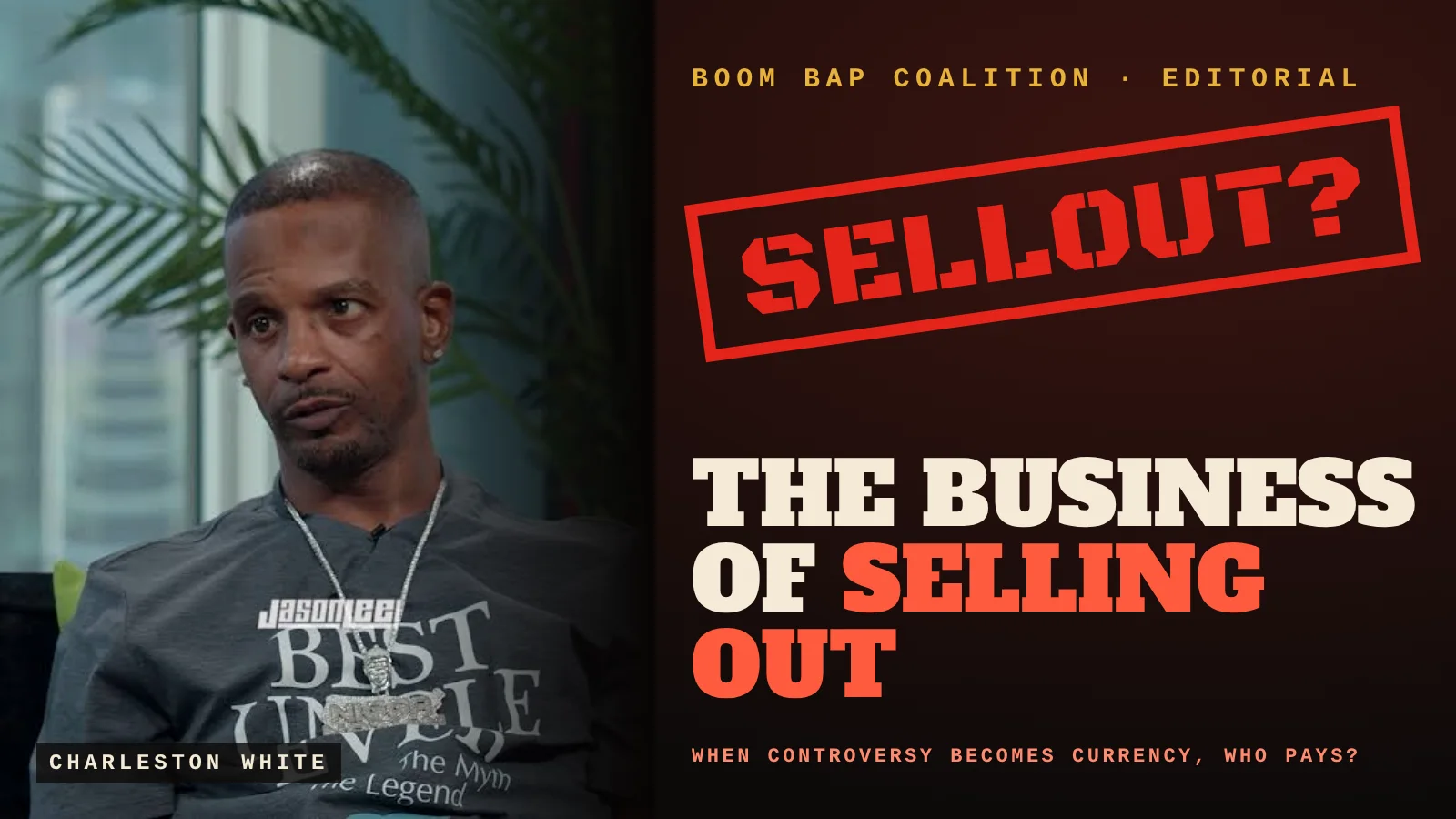
There was a time when Black entertainers were forced to perform degrading stereotypes just to get on a stage. The minstrel shows of yesterday made money by turning Black identity into a joke, a costume, and a spectacle.
Today, the stages have changed. We have podcasts, YouTube channels, viral interviews, television networks, and social media platforms. Nobody needs blackface to profit from controversy involving Black people.
But the question remains: Are we watching a new version of an old business model?
Controversy sells. Outrage generates clicks. Arguments create engagement. And in an entertainment economy where attention can be converted into money, the loudest voice often gets the biggest microphone.
That brings us to four recognizable personalities: Wack 100, Charleston White, Officer Tatum, and Stephen A. Smith.
Four different men. Four different careers. Four different approaches to public commentary.
But one question connects them: Where is the line between being outspoken, entertaining an audience, and contributing to the division of your own community?
Four voices, four different controversies
Wack 100 — When street politics becomes entertainment
Wack 100 has built a public presence around music management, confrontation, and outspoken commentary on hip-hop culture. His discussions frequently involve loyalty, credibility, and personal disputes.
But when private conflicts become public entertainment, are we informing the culture or turning its problems into content?
Charleston White — Is shock value a substitute for substance?
Charleston White has become known for provocative commentary about rappers, street culture, and public figures. He has also criticized the glorification of violence in hip-hop.
There may be legitimate messages buried beneath the controversy. But how much of the message survives when the insult becomes the headline?
Officer Tatum — Accountability or public condemnation?
Brandon Tatum, known as Officer Tatum, frequently discusses personal responsibility, family values, race, and politics.
His stated emphasis is on accountability and changing community values. But when criticism of particular behaviors becomes sweeping criticism of a community, does it encourage progress or reinforce damaging stereotypes?
Stephen A. Smith — The price of a powerful microphone
Stephen A. Smith has become one of America’s most recognizable sports commentators, expanding his public commentary beyond athletics.
Does having a powerful platform create a greater responsibility to consider how criticism is delivered, especially when discussing members of historically marginalized communities?
How far is too far?
Black people do not have to agree with one another. Unity does not mean silence. It does not mean protecting celebrities from criticism, defending destructive behavior, or pretending every Black public figure represents the entire community.
But there is a difference between holding people accountable and making humiliation a business model.
When a public personality criticizes violence, challenges hypocrisy, or demands better leadership, that conversation can be valuable.
When the conversation becomes a never-ending competition to embarrass, insult, and provoke, we should ask who benefits.
The personality gets attention. The platform gets engagement. The audience gets another argument.
But what does the community get?
Is Black unity gone?
Perhaps the biggest mistake would be to assume that what we see on social media represents all of Black America.
Black unity still exists in families, neighborhoods, churches, businesses, cultural organizations, and everyday acts of support. It simply doesn’t always generate the same attention as a celebrity feud.
The danger is allowing the loudest entertainers to define what Black America looks like to the rest of the world.
And maybe that is where the historical comparison becomes uncomfortable.
Yesterday’s minstrel performers operated within a racist entertainment system that rewarded degrading portrayals of Black people. Today’s Black commentators operate in a very different environment, with far more independence and opportunities for self-expression.
The two eras are not identical. But both raise an important question about the relationship between stereotypes, audiences, and profit.
The Boom Bap Coalition question
At what point does entertainment become exploitation?
At what point does criticism become disrespect?
And when does the pursuit of money, fame, and attention begin to overshadow responsibility to the people whose culture helped create the platform?
Wack 100, Charleston White, Officer Tatum, and Stephen A. Smith may answer those questions differently. Their audiences certainly will.
But perhaps the most important question isn’t whether these four men are selling out Black America.
It’s whether we, as an audience, have become so comfortable consuming conflict that we’ve forgotten how to reward unity.
Because if division gets the views, division will keep getting produced.
And if we want something different, we may have to change what we celebrate.
Boom Bap Coalition — Where the culture speaks for itself.